

If your last cleaning involved a hygienist scraping at your teeth with a metal tool while you white-knuckled the chair, you are not alone. That is the protocol most clinics in Canada still use. It works — but it can hurt, it leaves microscopic scratches on the enamel, and it often misses the soft bacterial film where most gum disease actually starts.
GBT — Guided Biofilm Therapy — does the same job in a completely different way. It was developed by EMS, a Swiss medical-device company, and it is the protocol we use at every Aviator visit.
Here is what makes it different, and why we made the switch.
What does GBT actually stand for?
GBT is short for Guided Biofilm Therapy. The “biofilm” part is the key word.
Biofilm is the soft, sticky bacterial layer that forms on your teeth every day. It is what turns into plaque, then tartar, then cavities and gum disease if it stays put. Old-school cleanings focus on the hard stuff — tartar — and scrape it off with metal instruments. GBT flips the priority: clear the soft biofilm first, then deal with whatever hard deposits remain.
The “guided” part is literal. Before any cleaning starts, we paint a harmless dye on your teeth that lights up exactly where biofilm is hiding. You can see it. We can see it. Nothing gets missed.
The eight steps, explained simply
GBT follows the same eight-step sequence every visit. EMS published the protocol so any clinic that uses their equipment is doing the exact same thing, the same way.
- Assessment. A standard look at your teeth and gums.
- Disclosing. We apply a coloured solution that stains biofilm so it is visible. This is where most patients say “wait, all of that is on my teeth?” The answer is yes — and we are about to remove it.
- Motivation. We walk you through what we are seeing and how to clean those spots at home. Five minutes of this saves you years of dental work.
- AIRFLOW®. A warm jet of water and ultra-fine erythritol powder removes biofilm and surface stains. It feels like a gentle, slightly tickly spray. No metal, no scraping, no sensitivity.
- PERIOFLOW®. For patients with deeper gum pockets or implants, we use a sub-gingival version of AIRFLOW that reaches under the gumline safely.
- PIEZON®. A piezoelectric ultrasonic instrument removes any remaining tartar using precise linear vibrations rather than the elliptical, side-to-side motion used by traditional ultrasonic scalers.
- Quality check. Check that all biofilm and calculus (tartar) have been fully removed.
- Recall. Plan your next dental treatment with your dental hygienist, tailored to your oral health and lifestyle needs.
The whole appointment usually runs 45–60 minutes for a healthy mouth.
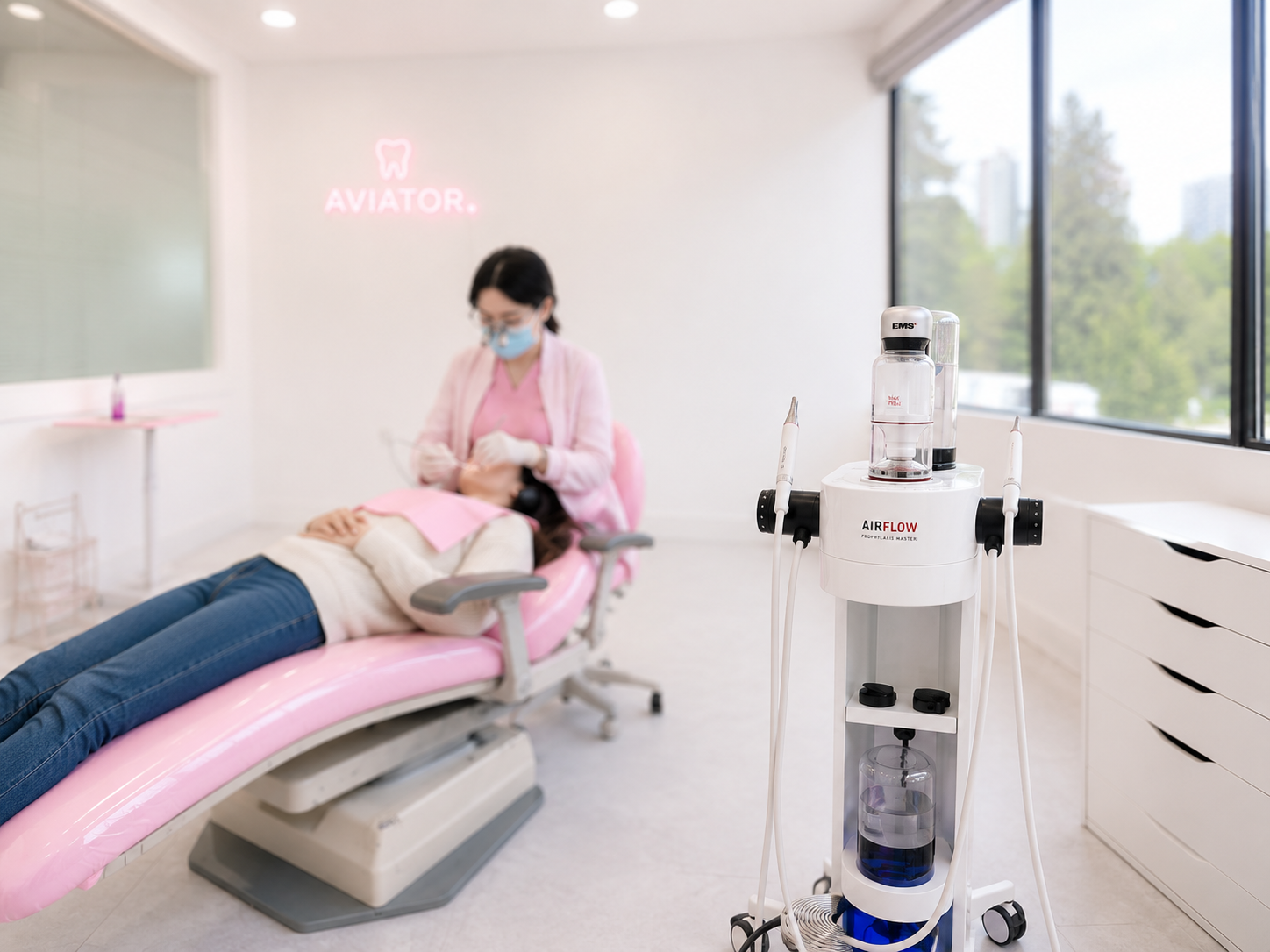
The room is part of the protocol. Calm space, calm patient, better cleaning.
Why we switched
We invested in GBT because three things kept showing up in the research:
- Less enamel damage. Erythritol powder is significantly less abrasive than the sodium-bicarbonate powders older airpolishing units use, and it does not leave the micro-scratches that metal scalers do. (See the recent British Dental Journal review on Guided Biofilm Therapy outcomes.)
- Better outcomes around implants and orthodontics. Brackets, wires, and implant abutments are hard to clean with hand instruments. AIRFLOW reaches them without damaging the surfaces.
- Patients actually come back. Cleanings that do not hurt are cleanings people keep. One of the most common reasons people skip recall appointments is fear or memory of pain.
That last one is the real reason. When the appointment does not feel like a punishment, prevention starts working the way it is supposed to.
What it feels like, the first time
Most patients describe the AIRFLOW step as “weirdly comfortable.” The water is warm. The powder has a slight sweet taste (erythritol is a sugar alcohol — non-cariogenic and safe for diabetics). There is no high-pitched scraping sound. No metal-on-tooth sensation.
For sensitive teeth, the difference is dramatic. Patients who used to dread cleanings often book their next appointment from the chair.

For kids, GBT is often their first painless dental memory — a calm visit, no metal, no scraping sound.
For patients with gum recession or implants, it is the only protocol that cleans those spots without making them worse.
Is it for everyone?
Almost. The main exception is patients on a low-salt diet who are sensitive to the small amount of sodium in the AIRFLOW powder — and even there, EMS makes an alternative powder. We talk through your medical history before every visit.
If you have not had a cleaning in two years or more and have significant tartar buildup, your first visit might still involve some traditional scaling alongside GBT. After the first reset visit, subsequent appointments are almost always pure GBT.
How to know if your current clinic does it
The easiest test: ask. If they have an AIRFLOW unit, they will tell you.
If you are in Burnaby, Langley, or Vancouver and curious to try it, we offer GBT cleanings at all three Aviator locations. New patients get a full assessment plus the cleaning on the first visit.
Book a GBT cleaning at Aviator →
Hwanhee Kim, RDH, is the founder of Aviator Dental Hygiene. The Aviator Dental Hygiene team provides care across three independent dental hygiene clinics in Burnaby, Langley, and Vancouver, where Guided Biofilm Therapy (GBT) is integrated as the standard protocol for every appointment.
